Why our notes

Built for Fast, Smart Revision

Everything is designed to save your time and lift your score.

✂️

Zero Fluff Summaries

Only exam-relevant points in short, crisp lines, so every minute of study counts.

๐Ÿ—บ️

Flowcharts & Visual Timelines

Mind maps, flowcharts and timelines turn heavy topics into pictures you remember.

๐ŸŽฏ

PYQ-Linked Key Points

Key points are linked to previous-year question trends so you know what matters most.

๐Ÿ“ฑ

Accessible on All Devices

Read on phone, tablet or laptop, or print a clean copy with the print-friendly layout.

Free Study Articles & Updates

NCERT Solutions For Class 10 Maths Chapter 4 Quadratic Equations Ex 4.4


NCERT Solutions For Class 10 Maths Chapter 4 Quadratic Equations Ex 4.4

Obtain Complimentary NCERT Solutions for Chapter 4 Ex 4.4 Quadratic Equations in Class 10 Maths. These Class 10 Maths NCERT Solutions are invaluable aids for completing homework assignments. The Exercise 4.4 Class 10 Maths NCERT Solutions were meticulously crafted by seasoned educators from School Notes Wallah. You can find comprehensive solutions to all the questions in Chapter 4 of the Class 10 Maths NCERT Textbook, specifically focusing on Quadratic Equations, in Exercise 4.4.

Topics and Sub Topics in Class 10 Maths Chapter 4 Quadratic Equations:

Section NameTopic Name
4Quadratic Equations
4.1Introduction
4.2Quadratic Equations
4.3Solution of a Quadratic Equation by Factorisation
4.4Solution of a Quadratic Equation by Completing the Square
4.5Nature of Roots
4.6Summary

You can also download the free PDF of Chapter 4 Ex 4.4 Quadratic Equations NCERT Solutions or save the solution images and take the print out to keep it handy for your exam preparation.

BoardCBSE
TextbookNCERT
ClassClass 10
SubjectMaths
ChapterChapter 4
Chapter NameQuadratic Equations
ExerciseEx 4.4
Number of Questions Solved5
CategoryNCERT Solutions

NCERT Solutions For Class 10 Maths Chapter 4 Quadratic Equations Ex 4.4

NCERT Solutions for Class 10 Maths Chapter 4 Quadratic Equations Ex 4.4 are part of NCERT Solutions for Class 10 Maths. Here we have given NCERT Solutions for Class 10 Maths Chapter 4 Quadratic Equations Ex 4.4.


EXERCISE 4.4
Q.1.    Find the nature of the roots of the following quadratic equations. If the real roots exist, find them:
             (i) 2x2 – 3x + 5 = 0                                                    (ii) 
             (iii) 2x2 – 6x + 3 – 0
Sol.      (i) 2x2 – 3x + 5 = 0
             Comparing the given quadratic equation with ax2 + bx + c = 0, we have:
             a = 2
             b= – 3
             c = 5
             ∴ The discriminant = b2 – 4ac
             = ( – 3)2 – 4(2)(5)
             = – 9 – 40
             = – 31 < 0
             Since b2 – 4ac is negative.
             ∴ The given quadratic equation has no real roots.
         (i) 

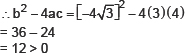
             Comparing the given quadratic equation with ax2 + bx + c= 0, we get
             
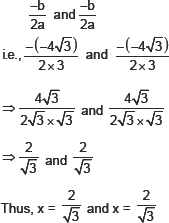
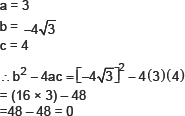
             Thus, the given quadratic equation has two real roots which are equal. Here, the roots are:
             
         (iii) 2x2 – 6x + 3 = 0
             Comparing it with the general quadratic equation, we have:
             a = 2
             b = –6
             c = 3
             
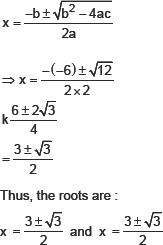
             ∴ The given quadratic equation has two real and distinct roots, which are given by
             
Q.2.    Find the values of k for each of the fallowing quadratic equations, so that they have two equal roots:
             (i) 2x2 + kx + 3 = 0
(ii) kx(x – 2) + 6 = 0
Sol.      (i) 2x2 + kx + 3 = 0
             Comparing the given quadratic equation with ax2 + bx + c = 0, we get
             a = 2
             b = k
             c = 3
             b2 – 4ac = ( – k)2 – 4 (2) (3)
             = k2 – 24
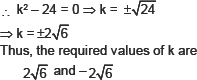
             ∵ For a quadratic equation to have equal roots,
             b2 – 4ac = 0
             
         (ii) kx(x – 2) + 6 = 0
         Comparing kx (x – 2) + 6 = 0 i.e., kx2 – 2kx + 6 = 0 with ax2 + bx + c = 0, we get
                   a = k
                   b = – a
                   c = 6
                   ∴ b2 – 4ac = ( – 2k)2 – 4 (k) (6)
                   = 4k2 – 24k
                   Since, the roots are real and equal,
                   ∴ b2 – 4ac = 0
                   ⇒ 4k2 – 24k = 0
                   ⇒ 4k(K – 6) = 0
                   ⇒ 4k = 0 or k – 6=0
                   ⇒ k = 0 or k = 6
         But k cannot be 0, otherwise, the given equation is no more quadratic. Thus, the required value of k = 6.
Q.3.    Is it possible to design a rectangular mango grove whose length is twice its breadth, and the area is 800 m? If so, find its length and breadth.
Sol.      Let the breadth be x metres.
             ∴ Length = 2x metres
             Now, Area = Length × Breadth
             = 2x × x metre2
             = 2x2 sq. metre.
             According to the given condition,
             2x2 = 800
             
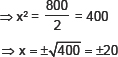
             Therefore, x = 20 and x = – 20
             But x = – 20 is possible                                (∵ breadth cannot be negative).
             ∴ x = 20
             ⇒ 2x = 2 × 20 = 40
             Thus, length = 40 m and breadth = 20 m
Q.4.    Is the following situation possible? If so, determine their present ages.
             The sum of the ages of two friends is 20 years. Four years ago, the product of their ages in years was 48.
Sol.      Let the age of one friend = x years
             ∴ The age of the other friend = (20 – x – 4) years                                [∵ Sum of their ages is 20 years]
             Four years ago
             Age of one friend = (x – 4) years
             Age of the other friend = (20 – x – 4) years
                   = (16 – x) years
             According to the condition,
             (x – 4) × (16 – x) = 48
             ⇒ 16x – 64 – x2 – 4x = 48
             ⇒ – x2 – 20x – 64 – 48 = 0
             ⇒ – x2 – 20x – 112 = 0
             ⇒ x2 + 20x + 112 – 0 (1)
             Here, a = 1, b = 20 and c = 112
             ∴ b2 – 4ac = (20)2 – 4 (1) (112)
             = 400 – 448
             = – 48 < 0
             Since b2 – 4ac is Is than O.
             ∴ The quadratic equation (1) has no real roots.
             Thus, the given equation is not possible.
Q.5.    Is it possible to design a rectangular park of perimeter 80 m and area 400 m2? If so, find its length and breadth.
Sol.      Let the breadth of the rectangle be x metres.
             Since, the parimetee of the rectangle = 80 m
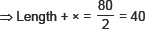
             ∴ 2 [Length + Breadth] = 80
             2 [Length + x] 80
             
             ⇒ Length = (40 – x) metres
             ∴ Area of the rectangle = Length × breadth
             = (40 – x) × x sq. m
             = 40x – x2
             Now, according to the given condition,
             Area of the rectangle = 400 m2
             ∴ 40x – x2 = 400
             ⇒ – x2 + 40x – 400 = 0
             ⇒ x2 – 40x + 400 = 0
             Comparing (1) with axe + bx + c = 0, we get
             a = 1
             b = –40
             c = 400
             ∴ b2 – 4ac = ( – 40)2 – 4 (1) (400)
             = 1600 – 1600 – 0
             Thus, the equation (1) has two equal and real roots.
             
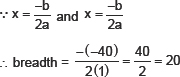
             ∴ Breadth, x = 20 m
             ∴ Length = (40 – x) = (40 – 20) m = 20 m.

✍

Thanks for reading. Share this with a friend who is preparing too.

Comments

Want the complete course?Get full notes, tests and expert support.Browse Premium Courses
Simple & easy

How It Works

Get your notes in three easy steps.

1

Pick your exam

Choose UPSC, SSC, Banking, Railways, State PSC or Defence and find the subject you need.

2

Preview a free sample

Flip through sample pages with Quick Look before you decide to buy.

3

Buy and download the PDF

Pay securely and download your notes to read or print on any device.

FAQ

Frequently Asked Questions

How do I download the notes after buying?

After your payment is complete you receive a download link for the PDF. Open it on any device and save the file for offline reading.

Can I print the PDF notes?

Yes. The notes use a print-friendly layout with clean margins, so you can print the pages you need or the full notes.

How often are the notes updated?

Notes are reviewed for each exam cycle and pattern change. The latest status is shown on every product card, for example Updated Pattern.

Can I see a sample before I buy?

Yes. Every notes pack has a free sample. Click Free Sample (PDF) or Quick Look to flip through sample pages before you pay.

Which devices can I use to read the notes?

The notes are PDF files that open on mobiles, tablets, laptops and desktops with any free PDF reader.

Are the notes available in Hindi and English?

The language of each pack is shown on its card. Use the search box to find notes in the language you prefer.